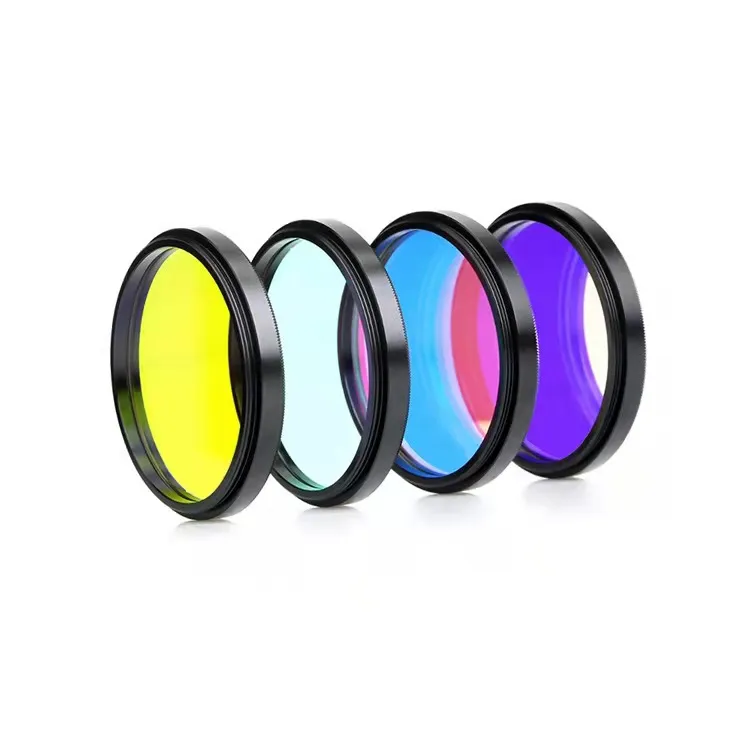
Every page in this filter family uses the word bandpass in its optical sense: a filter that transmits a defined wavelength band and rejects the light on either side of it. Jingsheng's storefront catalogue lists bandpass filters for fluorescence work, medical testing and face-recognition illumination at 850 and 940 nm. Documented examples include a multi-wavelength band pass glass covering UV, visible and near-infrared selections between 365 and 940 nm, and a customised optical band pass filter offered at 340, 505, 630 and 800 nm centre wavelengths.
Two catalogue listings show how the range is actually used. A green bandpass filter with a narrowband coating is sold for fluorescent applications. A narrow band pass filter built around a 520 nm centre wavelength is listed for medical tests. Both are reminders that a bandpass filter is specified by its centre wavelength and bandwidth first, and by its glass second.
Documented Bandpass Range
| Listing (storefront) | Detail | Documented MOQ |
|---|---|---|
| Multi-wavelength band pass glass | UV / IR cut / narrow bandpass selections, 365–940 nm | 1 piece |
| Customised band pass filter | 340 / 505 / 630 / 800 nm centre wavelengths | 1 piece |
| Narrowband green bandpass filter | Fluorescence applications | 10 pieces |
| Narrow band pass filter, CWL 520 nm | Medical test instruments | 10 pieces |
| Narrow band pass filters | 900 nm and 1640 nm white-glass versions | 10 pieces |
| Face-recognition bandpass filters | 850 nm and 940 nm narrow band pass | 10 pieces |
How a Bandpass Filter Is Specified
Four numbers lead the enquiry for a bandpass part: centre wavelength, bandwidth (the width of the transmitted band), peak transmission in the band, and blocking outside it. Add the angle of incidence your system uses — passband position can shift toward shorter wavelengths as the angle increases — and the clear aperture the beam needs. If your drawing already carries those values, send it as it stands; the quotation works from your numbers rather than from a house standard.
Buyers comparing this page with the optical filters overview should note the division of labour between the two: the overview maps the whole filter family, while this page is the deep specification page for bandpass parts alone. If your band is very narrow — a few nanometres around a laser line or a fluorescence emission — the narrow bandpass filters page covers that end of the range, and the bandpass selection guide walks through the specification step by step.
Ordering
Selected bandpass listings carry a documented minimum of a single piece, which makes evaluation units straightforward; most fluorescence and medical-test filters list 10 pieces. Prices and lead times are confirmed in the written quotation for your centre wavelength, bandwidth and quantity.
Frequently Asked Questions
What centre wavelengths are available?
Documented listings include 340, 505, 630 and 800 nm custom filters, a 520 nm medical-test filter, 850 and 940 nm face-recognition filters, and multi-wavelength glass spanning 365–940 nm. Other centre wavelengths are handled as custom orders — state yours in the enquiry.
Can I buy one filter to evaluate?
On selected listings, yes: the multi-wavelength and customised bandpass listings document a 1-piece minimum. Most application filters list 10 pieces.
Is this the same as an electronic bandpass filter?
No. These are optical filters — components that filter light, not circuits that filter signals. Glass is recorded for some entries in the filter range — a laser infrared optical colour glass bandpass / ND listing and a multi-wavelength band pass glass listing among them; where an entry's name does not record a base material, the material is confirmed per model in the enquiry.
Request a Quotation
Tell us the component, material, dimensions and coating you need. Pricing and lead time for your specification are confirmed in the written quotation.