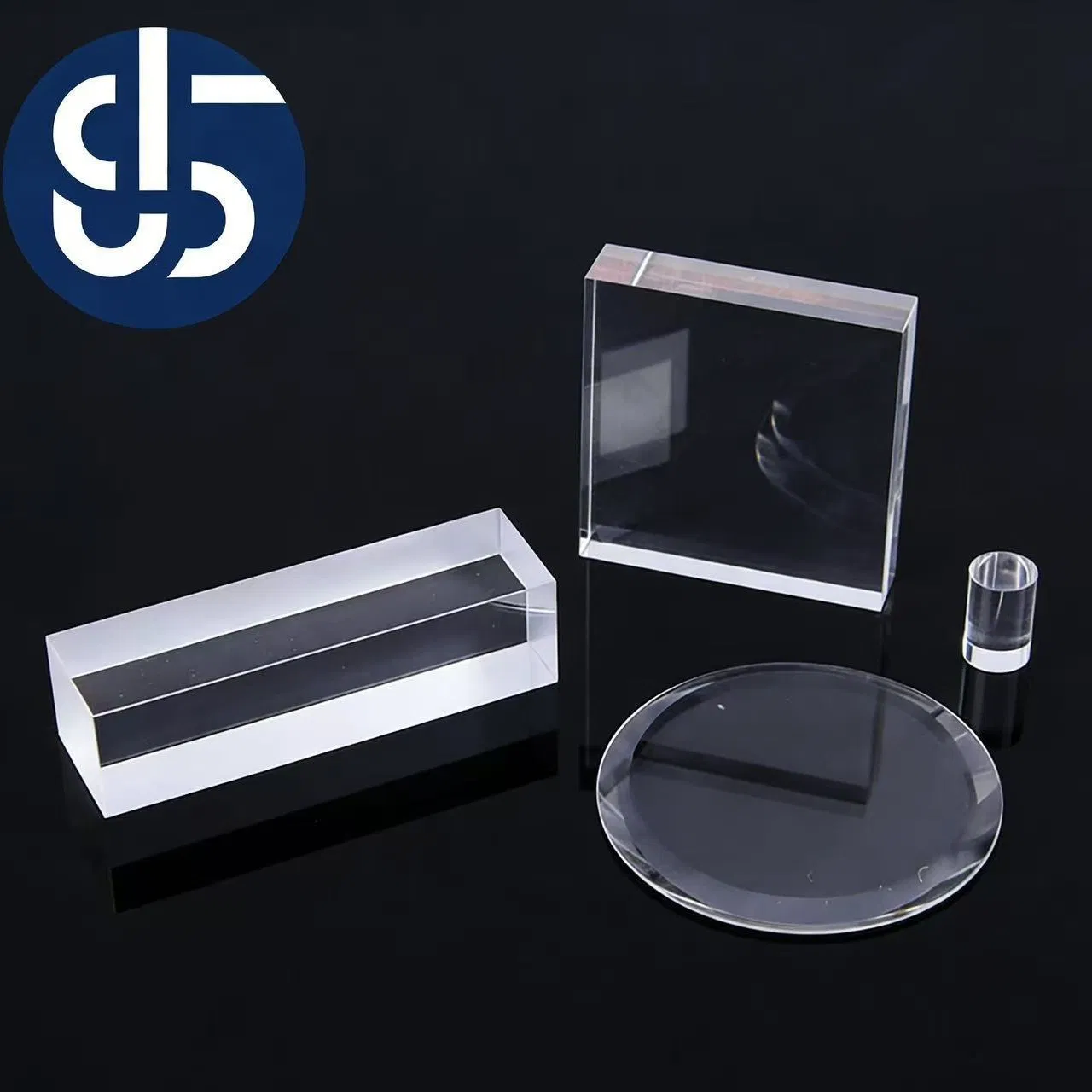
Windows are specified by material first and dimensions second, because the material decides the transmission band. The documented catalogue makes the point concretely: one listing bundles sapphire, K9, CaF2, MgF2, quartz, ZnSe, ZnS and infrared silicon windows in a single multi-material line, while individual listings go deep on the infrared workhorses — a ZnSe optical window with AR coating, and a combined ZnSe window plate / ZnS / calcium fluoride window plate line sold for CO2 laser service. A customised sapphire stepped window, machined with a step for mounting, shows the range also covers shaped parts, not only flat discs.
ZnSe Windows
Two documented listings: an AR-coated ZnSe window, and a ZnSe window plate listed for CO2 laser service; MOQ 10 pieces.
Sapphire Windows
Hard, strong window material; a customised stepped sapphire window is a documented listing.
Germanium Windows
Long-wave infrared window category. No germanium listing is recorded in the source catalogue; availability is confirmed by enquiry.
Choosing the Window Material
Work backwards from the wavelength. For visible and near-infrared work, the candidate materials are K9 or quartz-class glass; ultraviolet work points to fused silica and CaF2; the mid-infrared belongs to ZnSe and ZnS; thermal imaging in the long-wave band is germanium and ZnSe territory. The ZnSe versus germanium comparison works through the ZnSe-versus-germanium choice in detail.
Coating is the second decision. The documented ZnSe listing is AR coated: an uncoated high-index material reflects enough per surface to waste power and create ghost paths. State the wavelength the AR coating must serve when you enquire — a coating centred for a CO2 laser line is not interchangeable with a broadband visible coating. Brewster windows also appear in the window group for polarisation-sensitive laser cavities.
Frequently Asked Questions
What materials are documented?
ZnSe (with AR coating), ZnS, calcium fluoride, sapphire, K9, MgF2, quartz and infrared silicon, across the multi-material and single-material listings.
What are the minimum quantities?
10 pieces for the ZnSe window listing and for the customised stepped sapphire window listing; 30 pieces for the multi-material infrared window assortment, which also contains sapphire.
Can windows be shaped, not just round?
A stepped sapphire window is a documented listing, so machined profiles are part of the range — send the drawing.
Thickness, Flatness and the Specification Habits That Matter
Window enquiries fail on the unglamorous fields as well as on material. Thickness is a structural number before it is an optical one: a window that seals a pressure differential or carries a vacuum must be thick enough for the load across its unsupported diameter, and quoting the diameter without the pressure context invites a window that is optically perfect and mechanically wrong. Flatness and parallelism matter where the window sits inside an imaging path — a wedge in the window steers the beam, and surface figure shows up as distortion — while a window that only protects a sensor housing can be specified more loosely. The working habit is to attach three facts to every window enquiry: the clear aperture the beam actually needs (usually smaller than the flange), the pressure or sealing duty, and whether the window sits in an imaging path or a protection path.
Request a Quotation
Tell us the component, material, dimensions and coating you need. Pricing and lead time for your specification are confirmed in the written quotation.