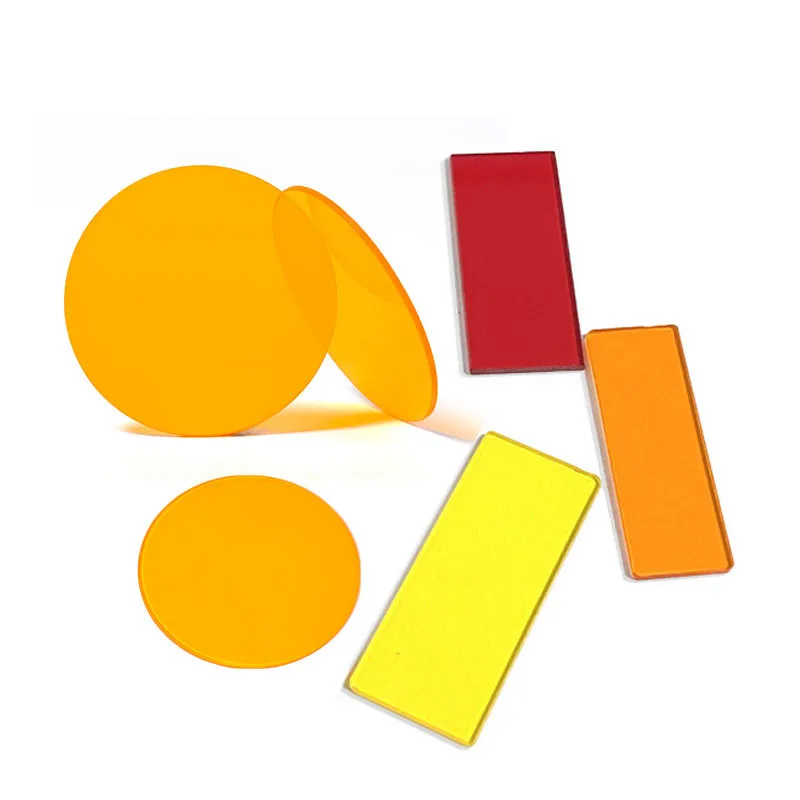
The sensor's response extends into the near-infrared, foliage and fabrics reflect infrared strongly, and without a filter that blocks it the image takes on a washed, pink-shifted cast. The manufacturer's documented listing states its application directly: an optical glass lens IR cut filter for sport cameras — the action-camera class where the filter is a small, precise piece of optical glass in front of a very small sensor.
The same catalogue holds the complementary part: an infrared transmitting filter for sensors, documented under that listing name. The two listings sit side by side in the filter group as separate entries. Both are documented at the same listed minimum; a product that needs a camera channel and a sensing channel can name both filters in one enquiry, and each is confirmed item by item in the quotation. Both listings sit inside the manufacturer's optical filter group, alongside the bandpass, longpass and shortpass families named in the same catalogue.
Documented Imaging and Sensing Filters
| Listing (storefront) | Application | MOQ |
|---|---|---|
| Optical glass IR cut filter | Sport cameras (action cameras) | 10 pieces |
| Infrared transmitting filter | Sensors | 10 pieces |
Specifying an IR Cut Filter
The cut wavelength — where the filter transitions from passing visible light to blocking infrared — is the headline specification, followed by the visible transmission requirement, the blocking depth in the near-infrared, the glass dimensions and thickness for the camera module, and any coating requirement. Small-format camera filters are a dimensions game as much as an optical one: state the module's filter seat size if you have it. For general instrument use rather than imaging, the shortpass filters page covers the same filter family.
Frequently Asked Questions
Why do cameras need an IR cut filter?
Because the sensor responds to infrared the eye cannot see. Unblocked, that response corrupts colour; the IR cut filter restores the sensor's view to the visible band.
Do you also supply the opposite filter — infrared pass?
Yes: an infrared transmitting filter for sensors is a documented listing, at the same 10-piece minimum.
What is the minimum order?
10 pieces on both documented listings.
Day/Night Cameras and the Switchable Exception
One application refines the IR cut story and is worth stating because it reverses the buying logic: surveillance and day/night cameras. By day these cameras need the IR cut filter in place for correct colour; by night they want the opposite — the infrared sensitivity the filter removes — so the filter is mounted in a switchable mechanism that moves it in and out of the path. The filter itself is the same class of component as the sport-camera part documented here, but the mechanism changes the specification conversation toward dimensions, thickness and the mounting format the switcher expects. If your camera design switches, say so in the enquiry: the glass can then be specified for the mechanism as well as for the spectrum. For the documented sport-camera class, the cut wavelength and the module's filter-seat dimensions are the fields the enquiry asks for first, with any further field confirmed against the module in the quotation.
Request a Quotation
Tell us the component, material, dimensions and coating you need. Pricing and lead time for your specification are confirmed in the written quotation.