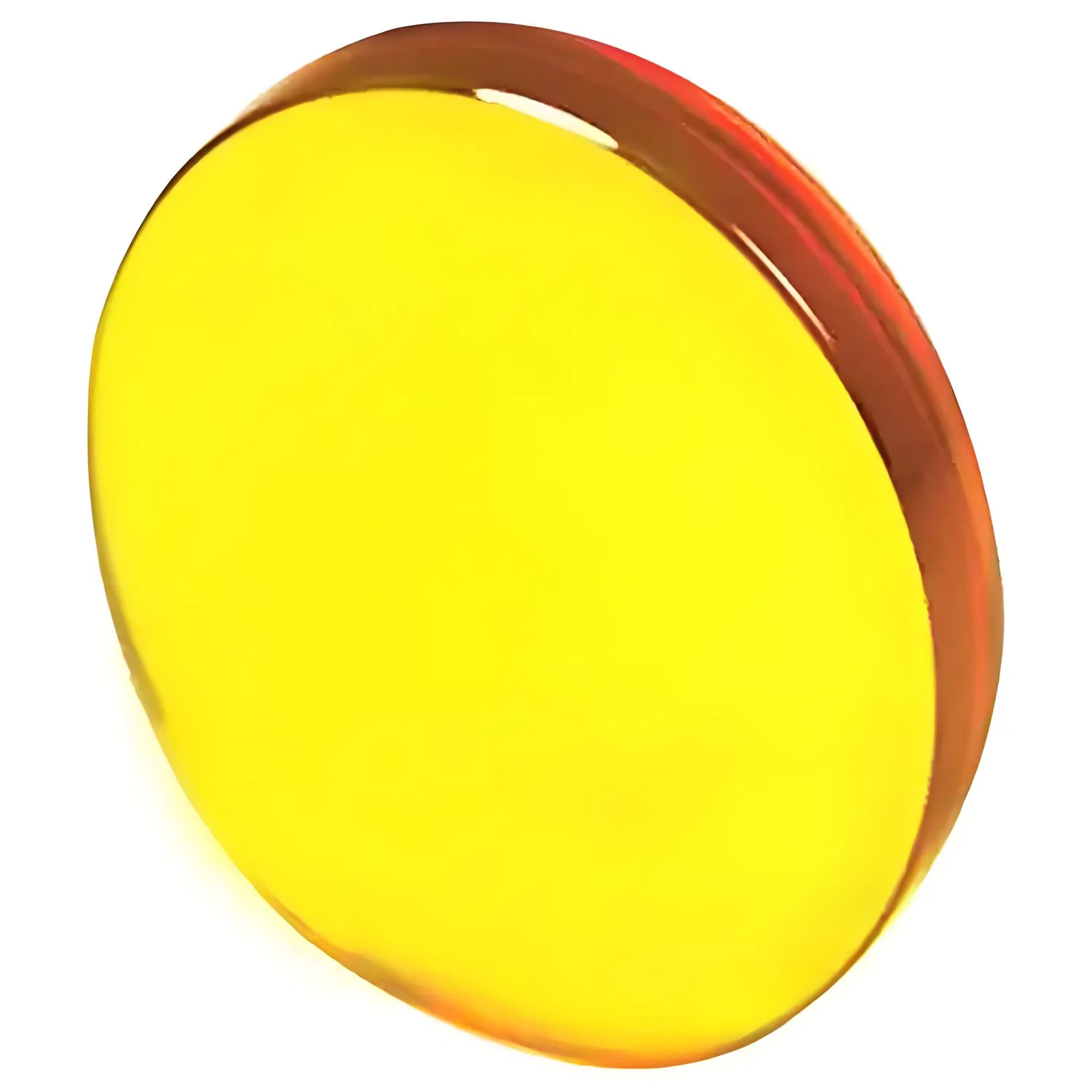
An infrared instrument design reaches a material fork early: the window (and often the lens) must be made from a material that transmits where the instrument measures. This comparison takes the two candidates in turn — zinc selenide and germanium. They overlap in the long-wave infrared and diverge almost everywhere else — in the bands they cover, in how they behave when hot, in how they survive handling, and in what drives their price. This comparison is asymmetric by design: ZnSe is a headline material in this manufacturer's catalogue with an AR-coated window listing, while germanium is not recorded as a documented Jingsheng listing in the source catalogue at all. The germanium side of this comparison is therefore a general material comparison, and any germanium purchase begins with a separate availability confirmation; the optical windows page records the documented material set.
Transmission: The Bands Decide First
Germanium transmits in the long-wave infrared — the thermal band where cameras image heat — and, usefully, in part of the mid-wave band, but it is opaque in the visible and near-infrared. That opacity is sometimes a feature: a germanium window can be aligned and inspected only with infrared instruments, but it also blocks visible light completely, which some systems want. ZnSe transmits far more widely, from the visible (it has a characteristic orange tint) through the mid-infrared to the long-wave band that CO2 lasers use at 10.6 micrometres. The first decision is therefore a band question. If the instrument is a thermal camera working only in the long-wave band, both materials are candidates. If it is a CO2 laser, the answer is ZnSe: ZnSe windows and focus lenses are the documented CO2 line in this catalogue. If the system needs a visible alignment channel through the same window, ZnSe is the only one of the two that can provide it.
Temperature: Where Germanium Gives Ground
Germanium's known weakness is thermal: as its temperature rises, its transmission in its own band falls, and a germanium window on hot plant can become progressively opaque to the very radiation the instrument exists to measure. ZnSe does not share that behaviour to anything like the same degree. The practical rule: if the window's working temperature is part of the instrument's problem statement, state the temperature in the enquiry and let it vote. If the instrument works at ordinary ambient temperatures, the point drops out of the decision and the other factors rule.
Mechanics and Handling: Two Different Kinds of Care
Neither material behaves like glass in the hand, but they misbehave differently. Germanium is dense — noticeably heavy for its size — hard and brittle, and it chips at edges if handled carelessly. ZnSe is softer, damages more easily on its faces, and demands respect in cleaning and mounting. Chemical compatibility is not a ranking between the two: whether either material tolerates a given aggressive medium depends on that medium, so compatibility for the specific environment should be confirmed in the enquiry rather than assumed from the material name. Both have high refractive indices, so an uncoated surface reflects a large fraction of the beam — on a window, that is lost signal and stray light in one — which is why coating is a live question for either material. The documented ZnSe window listing is AR coated; for a germanium part, coating availability would have to be confirmed with the part itself, because no germanium listing is recorded here.
Cost: What Actually Drives the Price
For both materials, price is quoted per part: the volume of material grows quickly with size, and germanium pricing additionally rides a metal market with other industrial demands on it, so a germanium figure belongs to its quotation date, as any metal-linked price does. The practical consequence for buyers is that 'which is cheaper' has no standing answer at catalogue level: the only meaningful comparison prices the actual size, thickness, coating and quantity for both materials on the same date. Quote the actual part before using cost as the tiebreaker.
The Decision, Compressed
Choose germanium when the instrument is a thermal imager or sensor working in the long-wave band at ordinary temperatures, especially where its visible opacity is acceptable or useful. Choose ZnSe when the system is a CO2 laser, when the window runs hot, when the band spans wider than germanium covers, or when a visible path must pass the same window. Where the environment is mechanically hostile and the band allows it, also price the third option — a sapphire window — because its strength changes the survival calculation even though its band is narrower. And when the choice remains genuinely open, order the band plan into the enquiry and let the quotation respond to the actual diameter and thickness; on infrared windows, that exchange settles more than any general comparison can. The component pages are ZnSe windows and germanium windows.
Frequently Asked Questions
Can germanium be used for a CO2 laser window?
ZnSe is the documented material for CO2 laser windows and focus lenses in this catalogue; germanium serves thermal-band instruments.
Which material handles heat better?
ZnSe. Germanium's transmission falls as its temperature rises, which rules it out for many hot-environment windows.
Which is cheaper?
There is no catalogue-level answer — price is quoted per part. Quote the actual size, thickness, coating and quantity for both materials on the same date before letting cost decide.
Technical References
For the general material statements in this comparison: RP Photonics, Infrared Optics buying guide (infrared material selection, including germanium temperature sensitivity and ZnSe bandwidth) and Edmund Optics, AR-coated germanium window (a current catalogue example of a coated germanium window; the temperature behaviour itself is covered by the RP guide above).
Edge Cases: When the Answer Is Neither
Two situations break the ZnSe-versus-germanium frame and deserve naming so buyers recognise them. The first is the diamond-window and sapphire-window territory of extreme environments: where pressure, particle impact or chemistry would destroy both candidates, the band may have to be renegotiated around a harder material rather than the material around the band. The second is the very large window: at large diameters the system answer sometimes moves to a segmented window, a smaller window with relay optics, or a different instrument architecture entirely. Both cases sit outside the ZnSe-versus-germanium frame, and recognising them early saves the quotation rounds that precede the redesign anyway. A supplier conversation that surfaces them — rather than quoting the impossible part cheerfully — is a sign the specification was actually read.
Writing the Enquiry That Settles It
The comparison above reduces, in the end, to five facts a buyer can state in a paragraph: the working band (and whether a visible path must share the window), the window's working temperature, the environment on both faces, the diameter and thickness, and whether the part is a window only or also carries focusing power as a lens. With those stated, the choice between ZnSe and germanium is made in the quotation against the facts as stated. Without them, the same purchase becomes a correspondence. The documented starting points are asymmetric and worth remembering: ZnSe windows are a listed, AR-coated, 10-piece-minimum product line, so a ZnSe enquiry can go straight to sizes; germanium is not a documented listing in the source record, so its enquiry must first ask whether the material and the part can currently be supplied, and only then discuss band and environment. Either way, the paragraph is the whole cost of certainty.