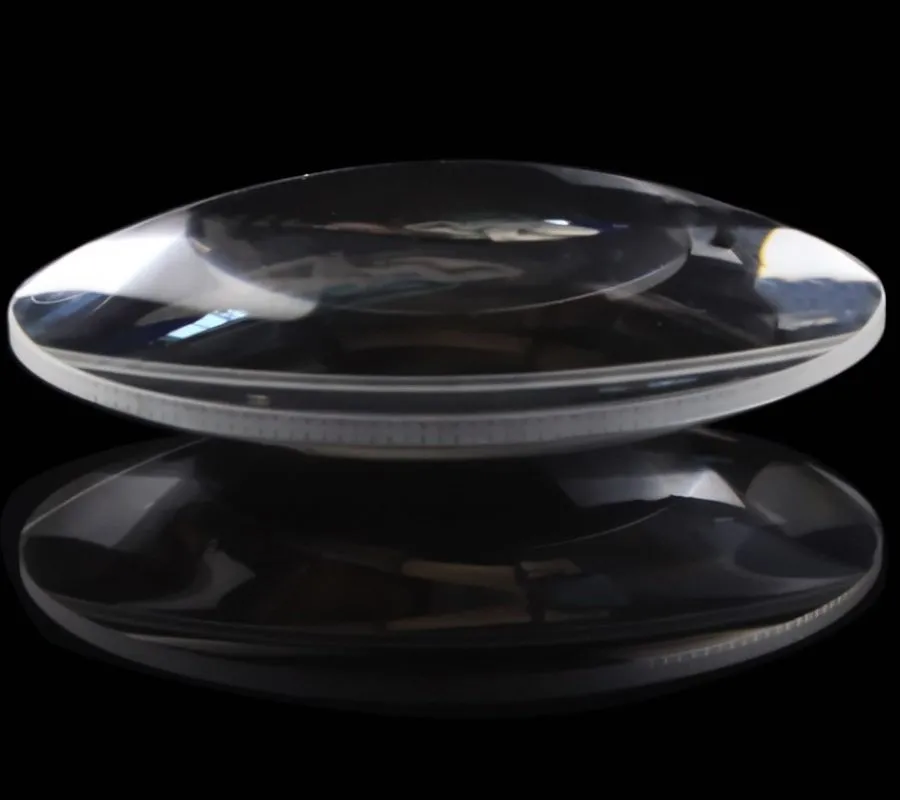
A biconvex lens bends light at both surfaces, which is why it outperforms a plano-convex element when the object and image distances are similar: the refraction is shared, and with it the aberration. That suits the double convex form to relay systems, simple imaging objectives, magnifiers and condenser pairs. The manufacturer's documented listings include a biconvex / double convex lens line with UV fused silica versions, and an 'optically perfect' double convex line aimed at DIY, education and industry users.
The fused silica point deserves emphasis because it changes the buying conversation: UV fused silica is the material the documented record names for one biconvex line, and the record does not state a material for the other double convex listings, so the enquiry should name the material the part is to be made in rather than leave it to be assumed.
Documented Biconvex Range
| Listing (storefront) | Documented detail | MOQ |
|---|---|---|
| Biconvex / double convex lens | Also listed in UV fused silica | 10 pieces |
| Double convex lens (DIY / education / industry) | DIY, education and industry use, as named in the listing | 10 pieces |
Specifying a Biconvex Lens
Diameter, focal length (or the two radii if the design is fixed), material and coating are the fields the enquiry asks for first. Because the biconvex form is chosen for conjugate symmetry, stating the intended object and image distances helps confirm the element suits the layout; where conjugates are very unequal, a plano-convex lens is usually the better singlet, and where aberration limits the design, the aspheric page is the next step. Achromatic doublets also appear in the wider lens group for colour-corrected duties.
Minimums on the documented biconvex listings are 10 pieces, and the biconvex / double convex line is recorded at FOB US$1–5 per piece. As with every component on this site, price and lead time for your diameter, material and quantity are confirmed in the written quotation — send the focal length and material first.
Frequently Asked Questions
Biconvex or plano-convex — which should I choose?
Biconvex when object and image distances are similar, because the power is shared between two surfaces; plano-convex when one conjugate is at or near infinity, such as focusing a collimated beam.
Is a UV version available?
Yes — a UV fused silica biconvex lens is a documented listing (Biconvex Lens / Double Convex Lens / UV Fused Silica Biconvex Lens). The source record does not state a material for the other double convex listings, so the material of a specific listing is confirmed in the enquiry.
What is the minimum order?
10 pieces on the documented biconvex listings.
The Symmetric-Conjugate Rule, Quantified in Practice
The practical test for choosing a biconvex lens is the conjugate ratio: divide the longer of the object and image distances by the shorter. Near one — object and image at similar distances, as in a relay or a unit-magnification imaging stage — the biconvex form is in its element and its two surfaces share the bending almost equally. As the ratio grows toward five or ten, the advantage drains away and a plano-convex element in the correct orientation takes over, which is why focusing a collimated beam (an infinite conjugate ratio) is plano-convex work. Magnifiers sit near the symmetric end, one more reason the double convex form is the magnifier form.
Request a Quotation
Tell us the component, material, dimensions and coating you need. Pricing and lead time for your specification are confirmed in the written quotation.